
Pipeline
Potential best-in-class therapies for neurodegenerative disorders
| Potential Indications |
Program | Mechanism of Action | Discovery | IND-enabling | Clinical | |
|---|---|---|---|---|---|---|
| Alzheimer’s disease | KRSA-028 | Anti-3pE amyloid beta mAb(THETA™-enabled) | ||||
| Undisclosed | Undisclosed | Undisclosed | ||||
| Undisclosed | Undisclosed | Undisclosed |
3pE-Aβ = Amyloid beta with post-translational pyroglutamate modification (pE) at the 3rd amino acid position, which is enriched in AD amyloid plaques
Korsana’s pipeline is led by a focus on Alzheimer’s disease.
The number of Americans with Alzheimer’s disease is projected to be around 13 million people by 2050, nearly double the number today. It is a disease with a massive and growing unmet need, with associated long-term healthcare costs projected to be over $1 trillion by 2050.
Despite the clear and significant burden, only two new disease-modifying therapies have been approved since 2003. Both are associated with high rates of amyloid-related imaging abnormalities (ARIA) and involve a high burden of care due to frequent intravenous infusions and MRI imaging. Moreover, multiple lines of evidence suggest these products do not maximize the efficacy achievable with this mechanism.
However, these first-generation therapies also validate the use of anti-amyloid-β antibodies as backbones to future, disease-modifying therapies in this indication. Together with our transferrin receptor (TfR)-based THETA technology, a well-established regulatory pathway, and an accelerated path to early proof of concept for both therapeutic activity and differentiation, Korsana is poised to rapidly develop the next generation of potentially best-in-class therapies for Alzheimer’s disease.

KRSA-028
KRSA-028 is an investigational, next-generation, THETA-enabled anti-amyloid-β antibody advancing the future of Alzheimer’s treatment.
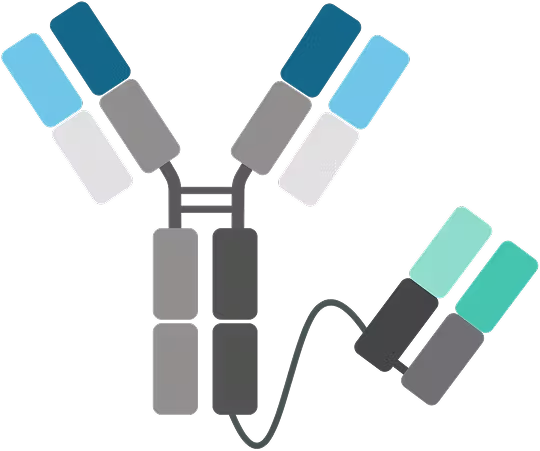
Proven Mechanism of Action
Utilizes an antibody backbone with a proven mechanism of action, binding the pyroglutamate forms of amyloid beta that are enriched in plaques. Antibodies targeting this epitope have shown in clinical trials to robustly clear amyloid plaque and slow progression of Alzheimer’s disease.
Best-in-Class Shuttling
Employs our Therapeutic Targeting (THETA) technology, designed to be a best-in-class brain-penetrant shuttle, delivering therapeutic cargo to sites of activity in the CNS. THETA leverages clinically proven biology by targeting TfR1 to achieve CNS penetration, and to bypass perivascular spaces around the choroid plexus – an approach shown in clinical trials to reduce the risk of amyloid-related imaging abnormalities (ARIA) which can be associated with severe adverse events.
Proprietary Fc Engineering
Incorporates selective effector function modulation to preserve plaque-clearing activity while avoiding deleterious immune system activation, in addition to half-life extension to reduce dose and dosing frequency.
Subcutaneous Delivery
Optimized for subcutaneous formulation, KRSA-028 is designed to achieve therapeutic efficacy at lower doses than first-generation therapies, eliminating the need for high-dose infusions and burdensome infusion center visits – bringing treatment closer to patients’ daily lives.